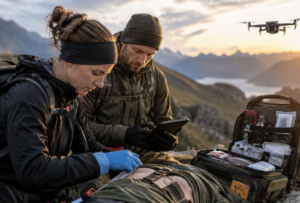
Emergency response has always depended on preparation, training, communication, and having the right equipment close at hand. What is changing rapidly is the technology surrounding those fundamentals. Modern information technology is giving emergency teams faster access to data, stronger communications, better location awareness, improved coordination, and new ways to manage incidents as they unfold.
For IT professionals, field technicians, infrastructure crews, security teams, telecommunications specialists, event personnel, and other workers operating outside a traditional office, this convergence of technology and emergency preparedness is becoming increasingly important. A connected device can provide information, but it cannot physically control bleeding, protect a wound, or supply the medical tools needed during the first critical moments of an injury.
That is why emergency preparedness is increasingly becoming part of the larger technology conversation.
The GP IFAK Level 2 represents that intersection between modern operational readiness and practical emergency medical capability. It reflects a larger shift taking place throughout the technology industry, where organizations are beginning to think beyond cybersecurity, software reliability, and network uptime and consider the physical safety of the people responsible for keeping those systems running.
IT Is Moving Far Beyond the Traditional Office
For decades, information technology was associated primarily with computer rooms, corporate offices, help desks, and data centers. That picture no longer reflects the reality of modern IT.
Technology professionals now work almost everywhere.
They install communications equipment on towers, maintain networking infrastructure at remote locations, support live events, manage security systems, service industrial facilities, maintain telecommunications networks, deploy temporary wireless systems, and support operations during severe weather and large public events.
Many of those environments create physical hazards that traditional office-based IT policies were never designed to address.
The technological systems surrounding those workers have advanced considerably. Smartphones provide GPS positioning. Connected radios allow teams to coordinate across large facilities. Cloud systems make operational data accessible from almost anywhere. Wearable devices can collect information about movement and physical conditions.
Even emergency communications systems themselves are evolving.
The National Institute of Standards and Technology maintains a dedicated Public Safety Communications Program focused on advancing critical communications capabilities for first responders. Its work reflects just how closely communications technology has become tied to effective emergency operations.
Yet even the most sophisticated communications platform ultimately supports people working in physical environments. Those people still need practical resources when an accident occurs.
Emergency Response Is Becoming an Information Technology System
Modern emergency response increasingly depends on information moving quickly between people, devices, vehicles, command centers, and healthcare providers.
The traditional emergency call has evolved into an interconnected communications environment involving computer-aided dispatch, digital mapping, GPS positioning, mobile data systems, broadband communications, electronic patient information, and real-time operational intelligence.
The basic concept of emergency medical services remains centered on providing urgent pre-hospital treatment and stabilization, but the technological infrastructure supporting that mission has expanded dramatically.
Dispatchers can see the location of responding vehicles. Incident commanders can receive information from multiple teams simultaneously. Emergency personnel may use tablets, ruggedized smartphones, digital mapping systems, body-worn technology, and specialized communications equipment while responding to an incident.
This has created an important change in how organizations think about readiness.
Emergency response is no longer simply a collection of medical supplies stored somewhere in a building. It is becoming a coordinated operational system in which information technology and physical preparedness work together.
Communications Technology Has Become Critical Infrastructure
Few technologies demonstrate the connection between IT and emergency preparedness better than communications systems.
During an emergency, information must move quickly and accurately. Dispatch centers need to understand what is happening. Responders need to know where they are going. Teams arriving from different organizations need to communicate. Supervisors need visibility into available personnel and resources.
The Cybersecurity and Infrastructure Security Agency describes interoperable emergency communications as essential to allowing emergency response organizations to share information securely and effectively across technologies and jurisdictions.
That principle applies far beyond police, fire, and ambulance services.
Large technology operations often contain their own miniature versions of this communications challenge.
A technician may be working on one side of a facility while another employee is located hundreds of yards away. A data center may have restricted areas that complicate access. Telecommunications crews may be operating in remote locations. Event technology teams may be spread across stages, production areas, electrical systems, and temporary structures.
When something goes wrong, the ability to communicate clearly becomes part of the response.
Physical emergency equipment fills another part of that same preparedness system.
Technology can help identify the emergency, transmit the location, contact additional assistance, document what happened, and coordinate the response. Physical medical supplies provide resources that may be needed during the minutes before professional emergency personnel arrive.
5G Is Expanding the Possibilities for Field Response
One of the most significant developments in public-safety technology is the continued evolution of wireless communications.
Traditional cellular networks have already transformed field operations, but newer communications architectures could make connected emergency response considerably more resilient.
In September 2026, NIST reported on research involving 5G sidelink technology, which can allow compatible devices to communicate directly under certain circumstances rather than depending entirely on traditional network infrastructure.
The potential implications are significant.
Emergency situations frequently damage the very infrastructure responders rely upon. Wildfires, hurricanes, flooding, electrical failures, structural damage, and large-scale incidents can interrupt cellular service or overload communications networks.
Direct device-to-device communication could allow personnel to continue exchanging critical information even when traditional network connections become unreliable.
For IT professionals, this development is particularly relevant because it demonstrates how emergency preparedness and network architecture are beginning to overlap.
The next generation of emergency systems may combine conventional radio communications, broadband networks, direct device connectivity, satellite communications, sensors, location tracking, and cloud-based incident management.
But no matter how advanced the network becomes, the response still reaches a physical person at the end of that network.
Emergency Data Is Becoming More Valuable
Information is another major part of the transformation.
Organizations increasingly rely on data to understand incidents, evaluate response times, allocate resources, and improve future preparedness.
The federal Office of Emergency Medical Services emphasizes the importance of collecting, analyzing, and sharing standardized EMS data to improve patient care, provider safety, and emergency operations.
That approach resembles what the technology industry has already learned from cybersecurity and network operations.
Modern IT departments rarely wait for a system failure before examining performance. They monitor networks continuously. They collect logs. They identify anomalies. They study incidents after they occur. They use historical information to improve future configurations.
Emergency preparedness is moving toward a similar model.
Incident information can reveal where accidents occur most frequently, how long responses take, what resources are typically required, and where preparedness gaps exist.
This creates an opportunity for IT departments to participate directly in organizational safety planning.
Technology teams often manage the systems capable of collecting and organizing this information. They understand data integration, device connectivity, communications infrastructure, dashboards, access controls, cybersecurity, and analytics.
As emergency operations become more data-driven, those skills become increasingly valuable.
Telemedicine Is Extending Medical Expertise Into the Field
Another important technological development is telemedicine.
Remote medical consultation has expanded significantly across healthcare, and emergency medical services are increasingly exploring ways to bring medical expertise closer to patients before they reach a hospital.
The National Library of Medicine describes how telemedicine can use electronic communications to exchange medical information and support care remotely in prehospital environments.
The concept creates several possibilities.
A responder in the field could potentially communicate with a physician or specialist while treating a patient. Video connections can allow medical professionals to observe conditions remotely. Diagnostic information can sometimes be transmitted before a patient reaches a hospital.
For remote workplaces and field operations, these capabilities could become particularly important.
A worker injured at a communications site, industrial facility, outdoor event, or remote infrastructure location may be far from immediate medical care. Reliable communications could help connect that location with emergency dispatchers or healthcare professionals.
Once again, however, digital access does not replace physical preparedness.
Information can tell someone what needs to be done. Communications can bring expertise into the situation. Medical supplies provide the physical resources necessary to perform appropriate first-aid actions while professional help is being arranged.
The most effective emergency strategy combines all three.
AI Could Become Another Layer of Emergency Technology
Artificial intelligence is beginning to influence nearly every major technology sector, and public safety is no exception.
AI systems may eventually assist with tasks such as interpreting sensor information, prioritizing incoming reports, identifying unusual patterns, organizing incident data, translating communications, or helping responders retrieve information without taking their hands away from operational tasks.
NIST has already explored projects involving AI-enabled hands-free technology for public safety.
Hands-free interaction is particularly valuable in emergency environments because responders may already be using both hands to perform critical tasks.
Voice-controlled systems could potentially retrieve maps, communicate with dispatchers, access procedures, document activities, or request additional resources without forcing someone to stop what they are doing and operate a touchscreen.
These systems will require careful testing, strong cybersecurity, dependable connectivity, and appropriate human oversight.
Emergency environments leave little room for unreliable information.
AI may become a powerful assistant, but human judgment, professional training, and dependable equipment will remain central to emergency response.
Cybersecurity and Physical Safety Are Beginning to Converge
The technology industry has spent decades developing cybersecurity strategies.
Organizations maintain firewalls, backup systems, authentication platforms, endpoint protection, redundant servers, disaster recovery plans, and incident response procedures.
The logic behind these investments is simple.
Critical systems must remain operational when something unexpected happens.
Physical preparedness follows the same principle.
A company would rarely operate an important server without backups. A network administrator would not intentionally create a single point of failure in a mission-critical system. Organizations create redundancy because unexpected events are inevitable.
Employee safety deserves the same operational thinking.
If technicians regularly work in environments where cuts, falls, equipment injuries, vehicle accidents, or other physical incidents could occur, preparedness should be considered part of operational resilience.
This does not mean every IT employee becomes a medical professional.
It means organizations begin thinking about physical emergency preparedness with the same seriousness they apply to digital incident response.
Connected Devices Are Changing Situational Awareness
Wearable technology and connected sensors may become another important element of emergency preparedness.
Modern devices can monitor location, movement, environmental conditions, temperature, heart rate, and other information depending on the application.
In industrial settings, connected systems may help identify dangerous environmental conditions before workers are exposed for extended periods.
Location technology can help supervisors determine where employees are working.
Automatic alerts may detect falls or unusual movement.
Smart helmets, connected protective equipment, and specialized wearable devices are already being explored across industries where employees work in hazardous environments.
This creates a broader concept of IT-powered safety.
Instead of responding only after someone reports an accident, connected systems may eventually help identify dangerous conditions earlier.
The strongest systems will combine prevention, detection, communication, and response.
Interoperability Matters When Multiple Teams Respond
Major incidents rarely involve only one organization.
Police departments, fire departments, EMS providers, hospitals, security teams, facility managers, public works departments, telecommunications companies, utilities, and private contractors may all become involved depending on the situation.
Communication failures between those organizations can create unnecessary delays.
CISA’s work on emergency communications coordination focuses heavily on interoperability and continuity of communications among public-safety organizations.
The same concept applies to private companies.
Different departments frequently use different communications platforms, software systems, mobile devices, and reporting procedures.
During routine operations, those differences may cause little trouble.
During an emergency, fragmentation becomes far more noticeable.
Organizations increasingly need emergency plans that account for how information moves between security personnel, IT teams, management, outside responders, and medical personnel.
Technology professionals can play an important role in building those systems.
The Future of IT Includes Human Resilience
Information technology has historically focused on machines.
Servers must remain operational. Networks must stay connected. Data must remain protected. Applications must remain available.
Modern IT is gradually expanding beyond that definition.
Organizations are increasingly recognizing that resilience includes the people who install, maintain, secure, transport, monitor, and operate the technology.
A resilient organization protects both infrastructure and personnel.
That means communications systems, emergency equipment, cybersecurity, physical security, employee training, medical preparedness, backup power, redundant networking, and disaster recovery should not exist as isolated programs.
They are parts of the same continuity strategy.
The companies that understand this convergence will be better positioned to respond when normal operations suddenly become abnormal.
Conclusion
The evolution of emergency response is increasingly being driven by technology.
Advanced communications networks are connecting teams across larger areas. GPS systems provide better location awareness. Digital dispatch platforms help coordinate resources. Data systems improve operational planning. Telemedicine can extend medical expertise into the field. Artificial intelligence is beginning to support hands-free information access, and next-generation wireless technologies may improve communications even when traditional infrastructure becomes unavailable.
Yet technology does not eliminate the need for practical preparation.
Digital systems and physical emergency resources perform different but complementary roles. One provides information, coordination, and connectivity. The other provides immediate tools that can be used when an injury occurs.
For IT departments, field operations teams, telecommunications companies, event technology crews, infrastructure providers, security organizations, and other technology-driven operations, that distinction is becoming increasingly important.
The future of IT resilience will not be measured only by whether servers remain online.
It will also be measured by whether the people responsible for those systems have the communications, information, training, and physical resources they need when an emergency happens.